-
Mobile Version
Scan with Mobile
- Member Center
Choosing the correct base material is fundamental to filtration performance, chemical compatibility, and service life. We offer a comprehensive range of metals to match your process media, temperature, and regulatory requirements.
Stainless steel is the dominant material for industrial filtration discs due to its excellent corrosion resistance, mechanical strength, and cost efficiency. 304 stainless steel filter discs provide reliable performance in water, air, oil, and mild chemical environments, with good resistance to organic acids and oxidizing agents. They are widely used in food processing, general industrial filtration, and water treatment where chloride exposure is limited.
316 stainless steel rimmed filter discs incorporate 2–3% molybdenum, delivering superior resistance to pitting and crevice corrosion in chloride-rich, saline, or acidic environments. For offshore oil platforms, marine filtration, chemical reactors, and pharmaceutical processes involving aggressive solvents, 316 and 316L (low-carbon) grades are the industry standard. Both 304 and 316 discs can be electropolished or passivated to enhance surface cleanliness and reduce particle adhesion.
Brass and copper wire mesh filter discs offer unique advantages in specific applications. Brass discs exhibit excellent machinability and good corrosion resistance in water and fuel systems, making them popular in automotive fuel filters, pneumatic systems, and musical instrument manufacturing. Copper filter discs provide natural antimicrobial properties and high thermal conductivity, ideal for steam filtration, HVAC systems, and certain food-contact applications. Bronze discs, particularly phosphor bronze, deliver exceptional wear resistance and fatigue strength for high-vibration environments.
For extreme environments, nickel alloy 200/201 filter discs offer outstanding resistance to caustic alkalis, while Inconel and Monel alloys tolerate high-temperature corrosive gases and seawater. Aluminum rimmed filter discs provide a lightweight, corrosion-resistant option for aerospace fuel filtration and weight-sensitive assemblies. Galvanized steel and carbon steel discs are available for economical, short-life applications where corrosion is not a primary concern. Our engineering team will cross-reference your process conditions against material compatibility charts to recommend the optimal alloy.
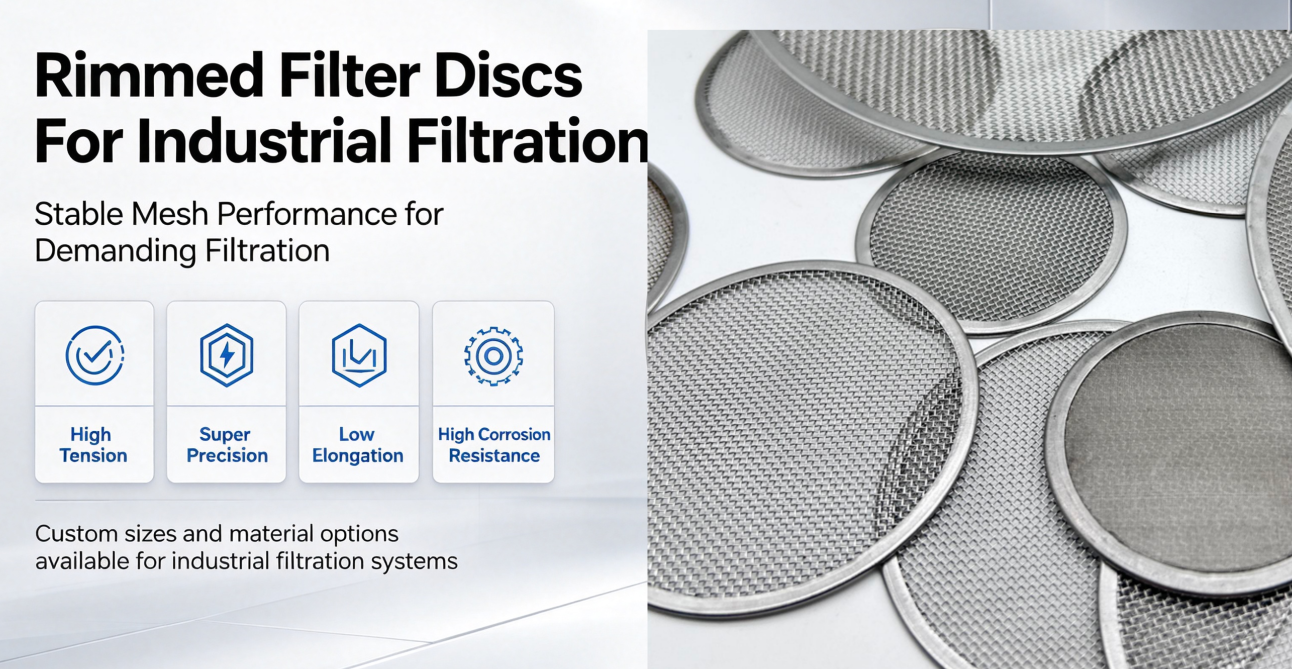
Rimmed filter discs are precision-engineered filtration components designed to deliver reliable particle separation across the most demanding industrial processes. Manufactured from high-grade woven wire mesh and finished with a reinforced peripheral rim, these discs provide superior structural integrity, consistent filtration accuracy, and leak-free sealing when installed in filter housings, pipeline strainers, and processing equipment. Whether you require a single-layer disc for coarse pre-filtration or a multi-layer spot welded assembly for sub-micron retention, our custom rimmed wire mesh filter discs are built to your exact dimensional, material, and performance specifications.
With filtration ratings spanning 12 to 1,000 microns and material options including stainless steel 304, 316, brass, copper, bronze, nickel alloy, and aluminum, our industrial filtration discs serve critical roles in oil and gas, chemical processing, pharmaceutical manufacturing, food and beverage production, water treatment, and automotive systems. Every disc is manufactured under strict quality controls to ensure uniform mesh tension, precise rim concentricity, and zero structural defects that could compromise filtration efficiency.
A rimmed filter disc is a circular or shaped wire mesh screen featuring a solid metal edge band — typically stainless steel, brass, or copper — that is mechanically wrapped, spot welded, or soldered around the mesh perimeter. This edge treatment, commonly referred to as a binding rim or frame, serves multiple functional purposes beyond simple aesthetics.
First, the rim prevents fraying and wire displacement during handling, installation, and high-pressure operation. Unprotected mesh edges are prone to unraveling when cut, leading to contamination of the filtrate and reduced service life. Second, the rim creates a flat, uniform sealing surface that mates precisely against gaskets, O-rings, and housing flanges, eliminating bypass flow that would otherwise allow unfiltered media to pass. Third, the reinforced edge significantly increases the disc's mechanical strength, enabling it to withstand differential pressures, pulsating flows, and mechanical cleaning cycles that would deform unsupported mesh.
For these reasons, rimmed wire mesh filter discs are the preferred specification over plain cut discs in any application where sealing integrity, operational safety, and long-term durability are non-negotiable.
While circular rimmed filter discs are the most common configuration, industrial equipment frequently demands non-standard geometries. We manufacture wire mesh filter discs in virtually any planar shape to match your housing design or flow dynamics.
Standard shapes include circular discs for inline strainers and pipeline filters; toroidal (ring-shaped) discs for annular filter assemblies; square and rectangular discs for panel filters and frame-mounted systems; and kidney-shaped, oval, and oblong discs for specialized medical and laboratory equipment. We also produce complex custom shapes from customer-supplied CAD drawings or physical templates, maintaining tight tolerances on outer dimensions, inner apertures, and rim width.
Diameter ranges typically span from 10 mm for precision instrument filters to over 1,000 mm for large-diameter pipeline strainers. Rim widths are adjusted proportionally to disc size and pressure rating, ensuring the edge reinforcement is structurally adequate without obstructing the active filtration area.
The number of mesh layers and their bonding method directly influence filtration efficiency, dirt-holding capacity, and mechanical robustness. We offer three primary construction types.
Single layer discs consist of one woven mesh sheet bound by a peripheral rim. This is the most economical configuration, offering high open area, minimal flow resistance, and straightforward cleaning. Single layer discs are ideal for coarse filtration applications, protective screening, and processes where frequent replacement is preferred over cleaning. They are also used as support screens beneath finer media in dual-stage assemblies.
Multi-layer spot welded discs combine two or more mesh layers of identical or differing micron ratings, joined by precision resistance welding at multiple points across the surface. The spot welding process fuses the layers at discrete locations, preventing delamination under pressure while maintaining inter-layer channels that enhance dirt-holding capacity. A typical configuration might pair a coarse outer layer (200 micron) with a fine inner layer (25 micron), allowing the coarse layer to capture large contaminants and extend the fine layer's service life. Spot welded multi-layer discs are widely used in hydraulic oil filtration, polymer extrusion, and chemical processing.
For applications requiring maximum edge integrity and high differential pressure tolerance, bound edge multi-layer discs encase the entire laminated mesh stack within a solid metal rim. The rim is mechanically compressed and sealed around the mesh perimeter, creating a unified structure with no exposed layer edges. This construction is preferred in high-pressure hydraulic systems, autoclave filtration, and sanitary processing where media bypass must be eliminated entirely.
The weave pattern of the wire mesh determines pore geometry, open area percentage, flow characteristics, and particle retention behavior. We manufacture rimmed filter discs using three primary weave architectures.
Plain weave is the most common pattern, with each warp wire passing alternately over and under each weft wire. This creates a uniform square aperture with consistent opening sizes, making plain weave ideal for general-purpose filtration where predictable particle retention is required. Plain weave discs offer high open area and low flow resistance, suitable for air, gas, and low-viscosity liquid filtration.
In twill weave, each warp wire passes over two weft wires and under one (or similar variations), creating a diagonal rib pattern. This structure allows heavier wire diameters to be used at equivalent mesh counts, producing a stronger, more durable screen with slightly reduced open area. Twill weave rimmed discs tolerate higher mechanical stress and are preferred for vibrating screens, shaker filters, and applications where the disc is subject to pulsating loads or cleaning scrapers.
Dutch weave employs thicker warp wires and thinner weft wires in a tight packing arrangement, creating a triangular or trapezoidal pore structure that is not visible as a standard "mesh" opening. This pattern delivers very high particle retention at elevated flow rates, with filtration ratings extending into the sub-25 micron range. Dutch weave filter discs are essential for hydraulic fluid polishing, polymer melt filtration, and fine chemical separation where absolute particle control is critical. Because dutch weave mesh is less permeable than square weave, disc sizing must account for the higher pressure drop across the media.
Our rimmed wire mesh filter discs are available across a broad spectrum of filtration ratings, precisely calibrated to international mesh standards. The filtration range extends from 12 microns for fine hydraulic and pharmaceutical filtration up to 1,000 microns for coarse debris straining and pre-filtration.
Common micron ratings and their typical applications include: 12–25 microns for hydraulic oil polishing and fine chemical filtration; 40–80 microns for fuel filtration, pneumatic systems, and paint straining; 100–200 microns for water treatment intake screens and process fluid pre-filtration; and 400–1,000 microns for large-particle straining, pump protection, and agricultural irrigation filters. Each rating corresponds to a specific mesh count and wire diameter combination, and our technical team provides certified filtration test data upon request.
Rimmed filter discs are integral components across a diverse range of industrial sectors, each with unique performance demands.
In upstream and downstream oil and gas operations, stainless steel 316 rimmed filter discs protect pumps, meters, and valves from sand, scale, and pipeline debris. Multi-layer spot welded discs handle high differential pressures in subsea and wellhead applications, while dutch weave discs polish produced water and injection fluids to prevent formation damage.
Chemical reactors and pharmaceutical manufacturing require filtration media that tolerate aggressive solvents, high temperatures, and strict cleanliness standards. Passivated 316L stainless steel discs and nickel alloy discs provide the chemical inertness and surface purity needed for API (active pharmaceutical ingredient) filtration, catalyst recovery, and solvent purification. Bound edge multi-layer discs ensure zero bypass in batch processes where cross-contamination risks are unacceptable.
FDA-compliant 304 and 316 stainless steel rimmed filter discs are used in dairy processing, brewery filtration, edible oil refining, and sugar syrup clarification. Electropolished surfaces meet hygienic design standards, and the open mesh architecture facilitates clean-in-place (CIP) protocols using caustic and acidic cleaning agents.
Municipal and industrial water treatment systems employ large-diameter rimmed filter discs in strainer baskets, self-cleaning filters, and reverse osmosis pre-treatment skids. The reinforced rim prevents mesh pull-out under high-flow conditions, while multi-layer configurations extend maintenance intervals in raw water intake applications.
Brass and stainless steel filter discs regulate contamination in fuel injection systems, lubrication circuits, and hydraulic actuators. Lightweight aluminum discs serve aerospace fuel and coolant filtration, where every gram matters and corrosion resistance is mandatory.
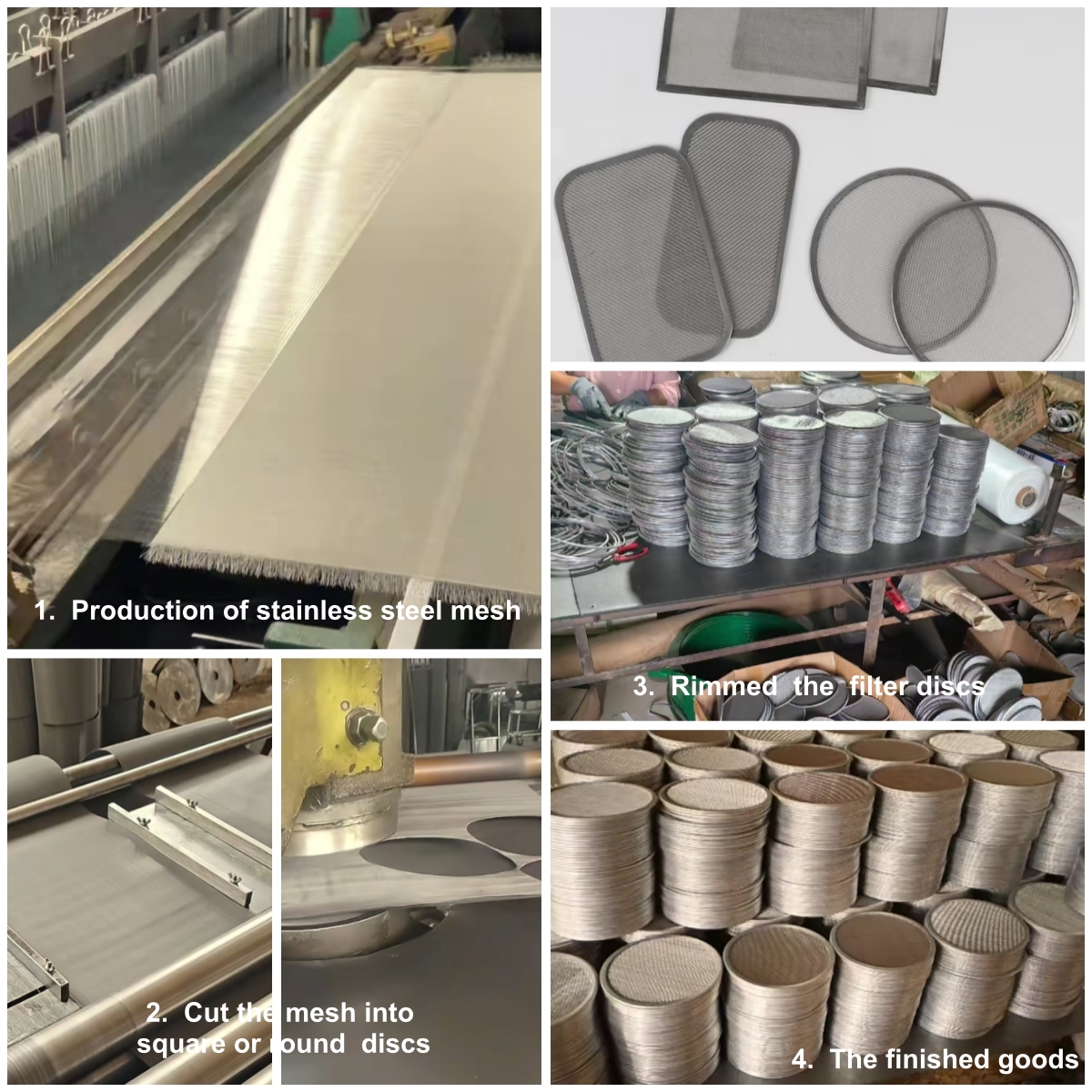
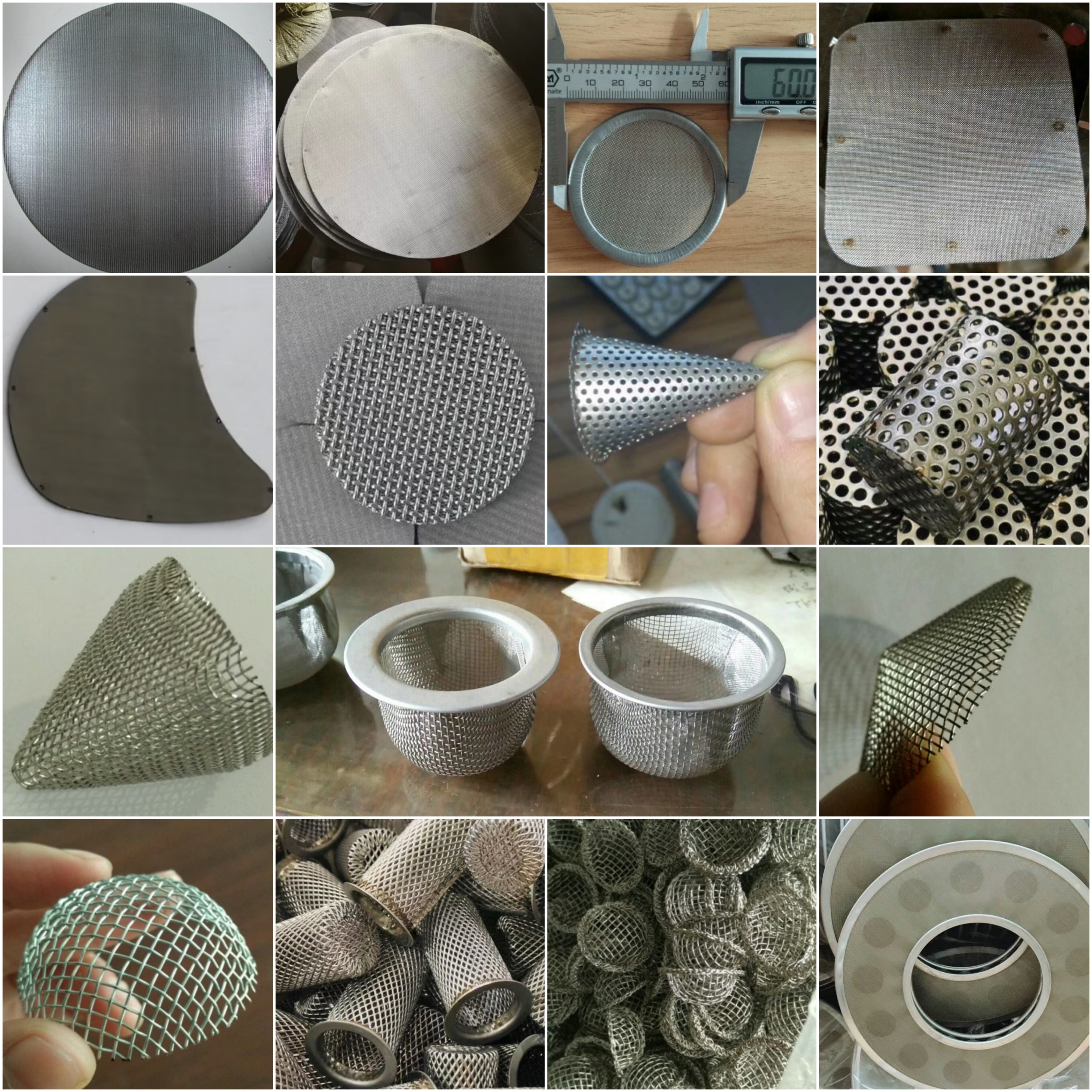
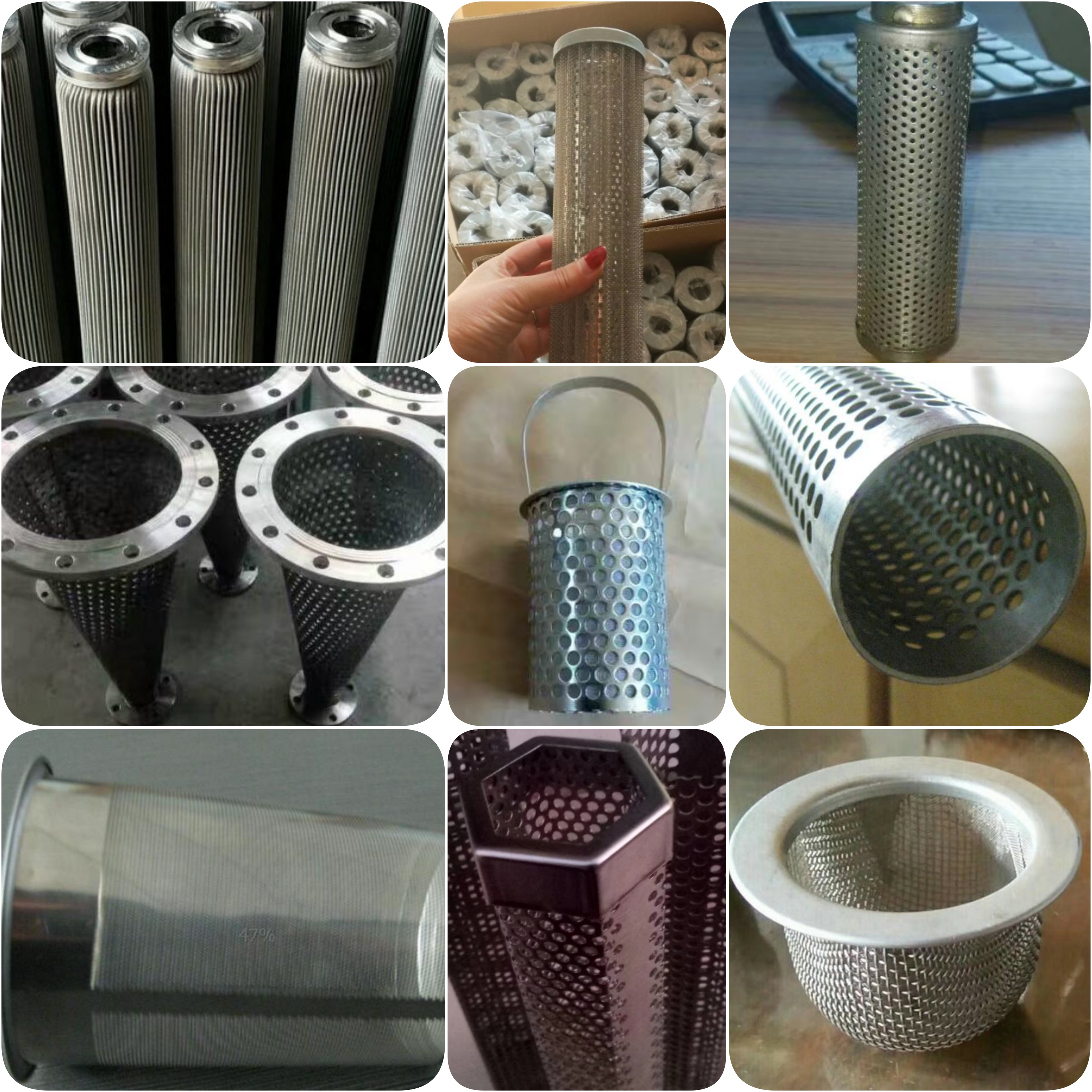
Our rimmed filter disc production follows a controlled workflow from raw material verification to final inspection.
Wire mesh is tension-leveled and cut using CNC die-cutting, laser cutting, or waterjet cutting depending on material thickness and shape complexity. Blanks are deburred and inspected for dimensional accuracy before rimming.
The rim is formed from strip metal matching or complementing the mesh alloy. For bound edge discs, the mesh blank is inserted into a pre-formed rim channel, and the assembly is mechanically compressed and sealed. For spot welded multi-layer discs, layers are aligned and resistance-welded at programmed intervals to ensure uniform bonding without thermal distortion of the mesh pores.
Discs undergo ultrasonic cleaning to remove oils and particulates. Optional passivation or electropolishing restores the corrosion-resistant oxide layer. Final inspection verifies rim concentricity, mesh flatness, filtration rating consistency, and absence of defects. Material test reports (MTR) and filtration validation certificates are provided with every order.
| Attribute | Specification Range | Notes |
|---|---|---|
| Materials | 304, 316, 316L SS; brass; copper; bronze; nickel alloy; aluminum; galvanized steel; carbon steel | Other alloys on request |
| Shapes | Circular, toroidal, square, rectangular, kidney, oval, custom | CAD-based custom tooling available |
| Layer Construction | Single layer; multi-layer spot welded; bound edge multi-layer | Up to 5+ layers for specialized applications |
| Weave Types | Plain weave, twill weave, dutch weave | Hybrid weaves available |
| Filtration Rating | 12 – 1,000 microns | Absolute and nominal ratings specified |
| Disc Diameter | 10 mm – 1,000+ mm | Larger diameters via segmented construction |
| Rim Width | 2 mm – 20 mm (typical) | Proportional to disc size and pressure rating |
| Surface Finish | Mill finish, passivated, electropolished | Ra values available for electropolish |
| Operating Temperature | Up to 800°C (stainless steel) | Material-dependent |
Rimmed filter discs feature a solid metal edge band that prevents mesh fraying, provides a flat sealing surface, and increases mechanical strength. Unrimmed discs are simply cut mesh blanks, suitable only for low-stress applications where edge sealing is not required. For industrial pipeline and housing installations, rimmed discs are strongly recommended.
We offer filtration ratings from 12 microns (fine hydraulic/polishing grade) to 1,000 microns (coarse straining grade). Intermediate ratings such as 25, 40, 80, 100, 150, 200, and 400 microns are standard stock options. Custom ratings can be engineered by adjusting mesh count and wire diameter.
Yes. Beyond standard circles, we manufacture toroidal, square, rectangular, kidney, oval, and fully custom shapes from your CAD drawings or physical samples. There is no tooling charge for shapes that can be produced from existing die sets.
For general chemical resistance, 316 or 316L stainless steel is recommended. For highly corrosive acids, chloride environments, or caustic alkalis, nickel alloys (Inconel, Monel, Nickel 200) may be required. Contact our team with your specific media composition for a compatibility assessment.
Spot welded multi-layer discs are joined at discrete weld points across the surface, offering good layer retention with maintained permeability. Bound edge multi-layer discs are sealed within a continuous rim, providing maximum edge integrity and pressure resistance. Choose spot welded for moderate pressure and cost efficiency; choose bound edge for high-pressure or sanitary critical applications.
Standard rimmed filter discs in common materials and sizes ship within 1–2 weeks. Custom shapes, multi-layer assemblies, or specialty alloys typically require 2–4 weeks. Rush orders and air freight can be arranged for urgent maintenance shutdowns or prototype validation.
Specify your ideal rimmed wire mesh filter disc today. Provide your required material, shape, diameter, filtration rating, layer configuration, and quantity, and our filtration engineers will respond within 24 hours with a detailed quotation, technical drawing, and lead time estimate. Whether you need a single prototype or a high-volume production run, we deliver precision filtration solutions engineered for your process.
Contact us now to discuss your industrial filtration requirements with a wire mesh specialist.







Long Press to Scan QR Code
Scan QR Code
